
Casey Lange · 12 October 2026
How Threaded Reply Structures Affect Knowledge Retention in Niche Digital Forums
Threaded reply structures organize conversations through nested responses that connect directly to specific comments rather than appearing in strict chronological order and this format appears across many niche digital forums where participants discuss specialized topics ranging from vintage audio equipment restoration to regional wildlife monitoring protocols. Researchers have examined how these structures shape the way users process and retain information over extended periods with data indicating variations in recall accuracy depending on whether discussions unfold linearly or through branching threads. Studies conducted in academic settings reveal that threaded formats often preserve contextual relationships between ideas which can support deeper encoding of details during reading sessions that last several minutes or more.
Core Mechanics of Threaded Systems
Forum software implements threading by assigning each reply a parent identifier so that responses appear indented beneath the original post or comment they address and this creates visual hierarchies that readers follow through expanding or collapsing branches as needed. Observers note that participants in niche communities frequently return to earlier branches when seeking clarification on technical specifications or historical references because the nesting keeps related exchanges grouped together. Data from platform analytics shows that users spend additional time scanning these nested elements compared with flat comment lists yet the extra navigation time correlates with improved identification of key facts during later retrieval tasks.
Evidence from Retention Studies
Multiple investigations have tracked knowledge retention through controlled experiments where participants read forum threads and then completed recall tests after intervals of one day or one week. Findings indicate that threaded structures yield higher accuracy rates when questions target relationships between statements rather than isolated facts and this pattern holds across forums focused on hobbyist electronics repair as well as those dedicated to local policy analysis. One study revealed that readers exposed to threaded versions retained sequence information about troubleshooting steps more reliably than those who viewed the same content presented linearly while another project documented similar advantages in environmental science discussion groups hosted on regional platforms.
Patterns Observed in Active Communities
Take one researcher who tracked activity on a specialized woodworking forum over several months and discovered that long threaded discussions about joinery techniques produced measurable increases in members' ability to describe correct tool sequences during follow-up interviews. Participants who engaged with deeply nested replies demonstrated stronger connections between cause and effect statements which appeared in their explanations of project outcomes. Data collected from similar environments shows that moderators often encourage threading when topics involve multi-step processes because it reduces fragmentation that occurs when replies stack without clear associations.
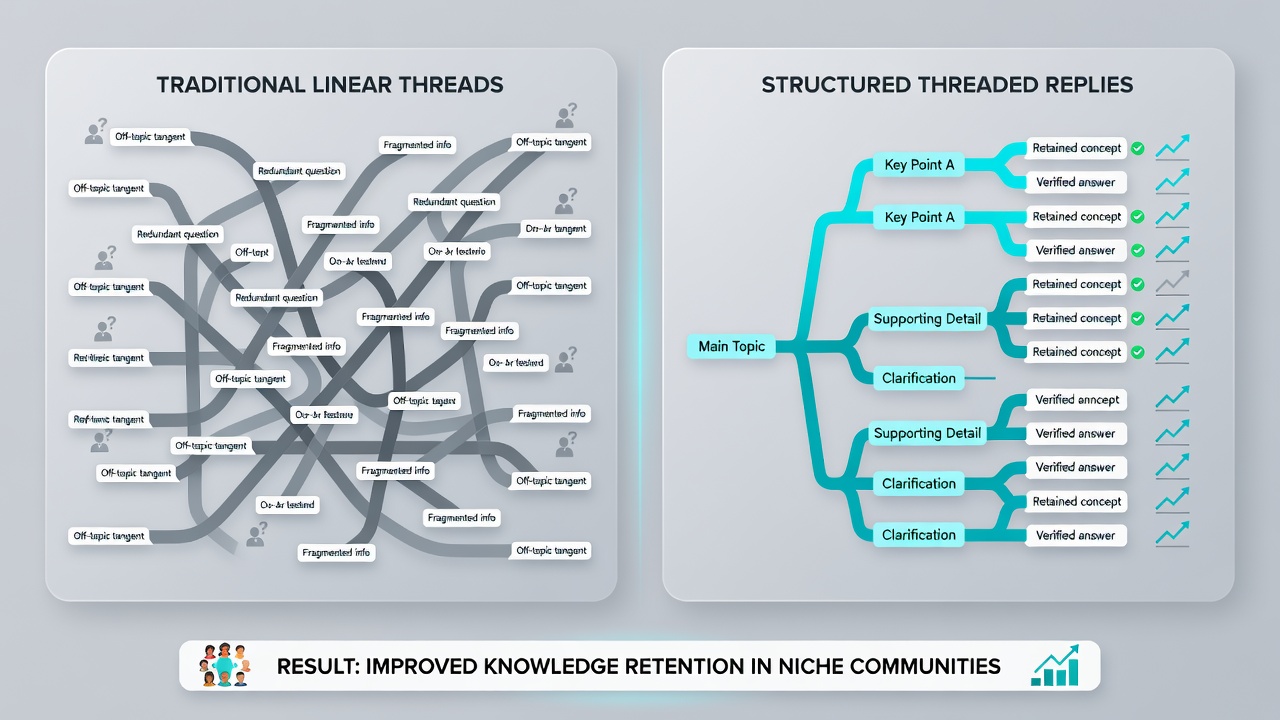
What's interesting is how threading interacts with search functionality inside these platforms because nested replies allow keyword matches to surface within their original context instead of pulling isolated lines that lose surrounding explanations. Researchers at the University of Melbourne have documented that community members locate previously encountered solutions faster when threads maintain clear parent-child relationships and this efficiency contributes to repeated exposure that reinforces memory traces over time. Figures from platform usage logs further reveal that retention benefits appear most pronounced when thread depth remains moderate rather than extending into dozens of nested levels that can overwhelm visual scanning.
Comparative Data Across Forum Types
Comparisons between threaded and flat structures in hobbyist photography communities demonstrate that threaded versions support better retention of equipment compatibility details while flat layouts sometimes aid quick scanning of recent updates. Academic reports compiled by Canadian research groups highlight that retention differences narrow when users possess high prior knowledge of the subject area yet persist among newcomers who rely more heavily on contextual cues provided by nesting. Evidence suggests that the organizational clarity of threads helps distribute cognitive load during initial reading sessions which leaves additional mental resources available for long-term storage of concepts.
But here's the thing: depth limits imposed by some forum administrators affect these outcomes because excessive nesting can obscure older contributions and reduce the likelihood that users revisit foundational comments. Platform data from European digital heritage forums indicates that moderate threading combined with occasional summarization posts maintains engagement levels that support repeated access and thereby strengthens retention through spaced repetition effects. Observers note consistent patterns where members who follow entire branches report greater confidence when applying discussed methods in practical settings such as equipment calibration or species identification protocols.
Conclusion
Threaded reply structures influence knowledge retention in niche digital forums by preserving contextual links between contributions and enabling targeted navigation that reinforces factual associations. Research indicates measurable advantages in recall accuracy for relational information while usage statistics demonstrate how these formats interact with user behaviors over repeated visits. Continued examination of platform configurations provides additional insight into optimal nesting levels that balance clarity with accessibility across diverse specialized communities.